
2026-08-07 · data
米国経済、7月に予想外の2万3000人雇用減
Abstract
Agrobiodiversity is a multi-dimensional concept underlying all sustained agricultural productivity. Agrobiodiversity plays especially important roles in complex multifunctional landscapes that blend smallholder production with remnant forests and semi-natural vegetation. We define agrobiodiversity broadly to include five levels of diversity that influence agricultural production: intraspecies genetic variation, diversity of species and varieties in the farmer's field, range of other species used in and around the farm, overall biodiversity of the landscape where the farm is situated, and large-scale agroecological zones or landforms. With specific reference to farming systems in hyperdiverse India, we highlight the essential roles played by agrobiodiversity in food security maintenance and examine key drivers of current agrobiodiversity loss. Innovative research and policy frameworks supporting agrobiodiversity conservation are urgently needed. We outline policies and initiatives needed to accelerate efforts to restore agrobiodiversity, and conclude by offering five actionable recommendations for rethinking agricultural research and development systems in India and the Global South. These shift the focus onto the essential networks of ecological relationships that support smallholder production. Especially in complex multifunctional landscapes, agrobiodiversity cannot be considered in isolation from wild biodiversity.
1 Introduction
Global food production systems face three simultaneous challenges: (1) sustained provision of calories and nutrients to the world's growing human populations, especially in the global South; (2) climate change adaptation and mitigation; and (3) maintenance of above- and below-ground agrobiodiversity, which has been dwindling due to increasing reliance on agrochemicals and monocropping. The agrobiodiversity challenge may be the most important of these, because meeting this challenge can help address the other two. Some studies indicate that biodiverse agroecosystems may provide better nutrition and may be more climate resilient than the ecologically simplified systems increasingly common in many parts of the world (e.g., TAAS, 2021; Cozim-Melges et al., 2024), but conclusive evidence is lacking, and outcomes may be highly location-dependent.
There has been considerable discussion recently about agrobiodiversity's role in sustaining agriculture (e.g., Jones et al., 2021; Banerjee et al., 2024; Cadena-Zamudio et al., 2024). Nevertheless, the concept of agrobiodiversity, its relationship with wild biodiversity, and its potential roles in landscape management remain poorly understood. There are few examples of how agrobiodiverse, multifunctional landscapes may be fostered and sustained at large spatial scales. Finally, there is a lack of discussion about the kinds of changes in leading institutions such as the Consultative Group on International Agricultural Research (CGIAR) and the National Agricultural Research Systems (NARS) that may be necessary to bring about large-scale transformation.
Here we address the agrobiodiversity challenges for food production systems in the Global South. In many regions, agricultural practices that rely on synthetic inputs are rapidly replacing traditional farming systems based on agroecological principles. More than half a century after the advent of Green Revolution agricultural practices, observations of social and ecological harms are proliferating. We ask what kinds of policy frameworks would be needed to adapt and adjust these practices to make agroscapes more biodiverse and more resilient to environmental shocks without sacrificing productivity.
We take India, one of the world's largest and most diverse agricultural systems, as an example. We first consider the concept of agrobiodiversity, redefining it as more than the diversity of crops or soil organisms. We then examine the drivers of agrobiodiversity loss, outlining policies and initiatives needed to accelerate efforts to restore agrobiodiversity. To conclude, we briefly discuss the roles of policies and research systems in facilitating and accelerating the needed changes. Our recommendations for increasing agrobiodiversity are widely applicable, especially across South Asia, where cultural-social-economic contexts are comparable. Our contribution is policy-specific, offering pathways to fostering agrobiodiversity in India and other parts of the world—pathways that could potentially benefit many millions of people.
2 Rethinking agrobiodiversity
'Agrobiodiversity' is the totality of plants, animals, and microorganisms that coexist and interact across agricultural landscapes—as well as their underlying genetic diversity. In 1999, the FAO described agricultural biodiversity as "the variety and variability of animals, plants and micro-organisms that are important to food and agriculture, which result from the interaction between the environment, genetic resources and the management systems and practices used by people" (FAO, 1999). Twenty years later, FAO's definition had not changed much (FAO, 2019). Such definitions leave much unspecified. Case-based applications of the term often focus narrowly on the organisms and processes that contribute directly to agricultural production, such as pollination, pest control, and nutrient cycling (e.g., Hussain and Qamar, 2020; Jones et al., 2021; Banerjee et al., 2024; Cadena-Zamudio et al., 2024; Hailu, 2025).
To facilitate a transition away from dependence on synthetic inputs (fertilizers, pesticides), especially in complex landscapes with smallholder production, we advocate for a broader view of agrobiodiversity. We foreground the extensive network of ecological relationships influencing smallholder productivity in and around the farm, and even at considerable distances in space and time. These influences are not necessarily supportive—agrobiodiversity is not to be confused with ecosystem services. The disservices imposed by crop pest herbivores, invasive species, disease vectors, and human-wildlife conflict (e.g., crop raiding) may determine a season's outputs as much as the services.
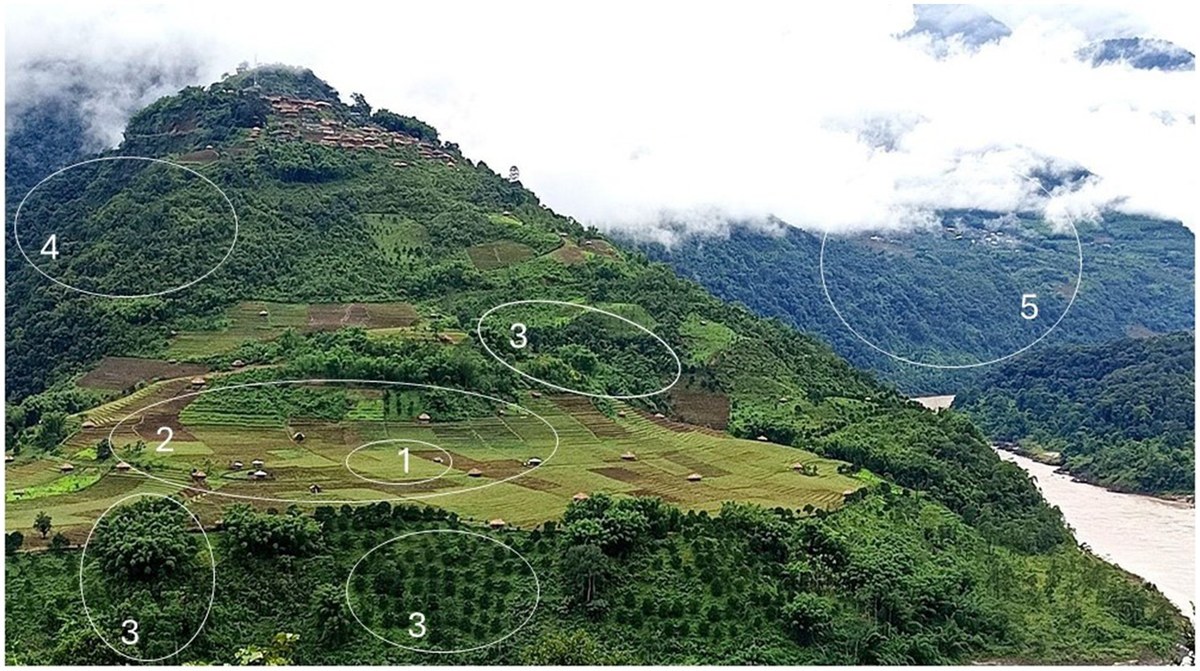
As shown in Figure 1 (depicting a landscape in the state of Arunachal Pradesh, India), agrobiodiversity is not something abstract. It can be observed in traditionally-managed contemporary landscapes at multiple levels: (1) genetic variation within each crop and livestock species, (2) diversity of crops, livestock and the varieties of each in the farmer's field, (3) range of other plant and animal species used in and around the farm, (4) overall biodiversity of the landscape where the farm is situated, and (5) large-scale agroecological zones or landforms that add a fifth layer of diversity and constitute the species pool from which lower-level agrobiodiversity is selected.
Importantly, the boundaries among the five layers in Figure 1 are notably permeable. Wild biodiversity and agrobiodiversity overlap and interact continuously, providing each other with key resources at the landscape level—pollination services, forage for pollinators, control of crop pests, soil fertility maintenance, flood control, and many other environmental benefits (Pywell et al., 2015; Dainese et al., 2019; Woodcock et al., 2019; Cole et al., 2022; Díaz-Siefer et al., 2022; Frank, 2024). The critical below-ground biodiversity extends across all 5 layers. All food production systems and nutritional security are founded on this combined biodiversity (Frison et al., 2011; Díaz et al., 2019). As climate change intensifies, prospects for developing climate-resilient agriculture increasingly rely both on biodiversity on farms and on the wild biodiversity of surrounding landscapes. Thus, 'agrobiodiversity' needs to be reconceptualized as a broad range of species and ecological interactions surrounding and influencing farm production systems both above- and below-ground.
3 Loss of agrobiodiversity is pervasive
India is rich in wild plant biodiversity, harboring approximately 18,000 species of vascular plants. One of Vavilov's eight centers of origin for cultivated crops, the subcontinent has been exceptionally rich in the precursors to genetic and species-level diversity in domesticated agricultural systems. However, Dulloo et al. (2021) concluded that over 75% of farmers' crop landraces are vulnerable, threatened or already lost today, and that rapid interventions are needed to prevent "large-scale genetic erosion."
Over 100,000 varieties of rice were estimated to have existed in India before the advent of the Green Revolution (Richharia and Govindasamy, 1990). More recent statements have repeated this estimate without verifying it. Today, it appears that there may be around 7,000 extant rice varieties in India, but most of these varieties are not found in markets. Perhaps 15–20 common varieties dominate the rice market (Shah Enterprises, n.d.).
The process of defining and registering indigenous livestock breeds is ongoing and incomplete, but it appears that the population of indigenous cattle breeds is shrinking (e.g., by 6% between 2012 and 2019: Shagun, 2023), while the population of exotic and mixed breeds is expanding (Singh and Sharma, 2017). As long ago as 2009, MoEFCC (2009) worried that half of the indigenous goat breeds, a third of sheep breeds, a fifth of cattle breeds and almost all poultry breeds were threatened. This pattern of homogenization and simplification of agricultural systems is closely linked with the overall decline and degradation of natural ecosystems, as well as the increasing sensitivity of India's farmers to market forces. The loss of resilience often associated with increasing productivity may be risky under conditions of climate change.
Of course, agrobiodiversity loss and reduction are not limited to India. Global conservation assessments from the IUCN Red List cover 30% of known edible plant species, with 11% classified as threatened. Traditional crop varieties are still used in some regions, but of the >6,000 plant species cultivated globally for food, just nine contribute two thirds of total crop production, while a quarter of the world's local livestock breeds are believed to be at risk of extinction.
4 Why are we losing agrobiodiversity?
The fundamental driver of agrobiodiversity decline in India is the rapid transition from traditional agroecosystems to 'intensive' agricultural systems characterized by monocropping of high-yielding agricultural varieties and heavy reliance on synthetic inputs. In the short run (over 50–60 years), such systems have provided calories and food security for expanding populations, but the social and environmental costs of this system have been documented and continue to mount (Bawa and Seidler, 2023). Indian agriculture reports severe losses of soil quality and productivity in many places (Joshi et al., 2023). Here we focus specifically on the loss of agrobiodiversity associated with chemically intensive systems in India, suggesting that biodiversity loss also underlies many other emerging crises.
The factors that hinder the maintenance and sustainable use1 of agrobiodiversity may be broadly categorized as (1) loss of genetic diversity at the intraspecific (crop) level, (2) loss of cropping system diversity at the farm level, and (3) reductions in ecosystem (landscape-level) diversity. Progress in each of these areas has been constrained by government policies, by markets, and by institutional arrangements (see Table 1). Consequently, many farm systems struggle to meet the needs of the present and immediate future, while ignoring the needs of the slightly more distant future. Below we examine each of these factors in turn (summarized in Table 1).
Challenges in agrobiodiversity conservation and sustainable use: India.
4.1 Loss drivers, levels 1 and 2: intraspecific (genetic) diversity and cropping system (farm-level) diversity
4.1.1 Policies
Government policies in India, as in other countries, have prioritized maximizing yield, productivity, and the chemical intensification of agriculture, promoting modern varieties (MVs) of major crops. Neglected and underutilized crop species (NUS) still receive low priority in research, promotion, and extension efforts. Importantly, synthetic fertilizers continue to be heavily subsidized in India. Over 20 years, these subsidies have increased by >10 times, today making India the world's second-largest consumer of chemical fertilizers (Gupta, 2023). Nitrogenous fertilizers (urea) are subsidized by up to 90% (Das et al., 2024), and over 40 years, average per hectare annual fertilizer consumption in India has risen from 25 kg to 145 kg (Das et al., 2024). This compares with just 17 kg/ha in Sub-Saharan Africa (despite subsidy programs in many countries), 124 kg/ha in EU, 128 kg/ha in USA, and a global average of 136 kg/ha. In India, many farmers become dependent on subsidized commercial fertilizers, often going deeply into debt to purchase them up front.
Even more seriously, synthetic fertilizers are commonly used in grossly disproportionate amounts. According to NAAS (2009), soils in different regions of India call for N, P and K to be introduced at ratios of around 4:2:1 or 4:2:2. [More geographically nuanced accounts are found in Chand and Pavithra (2015) and Das et al. (2022)]. However, the Fertiliser Association of India (FAI, 2023) reports that because urea is so heavily subsidized, average use ratios of N:P:K across India were close to 8:3:1 in 2022, rising to nearly 12:5:1 in 2023. Well-documented harms from imbalanced fertilizer application include loss of soil organic matter (soil compaction, reduced fertility), nitrate leaching (eutrophication of waterbodies, nitrates in drinking water, "blue baby syndrome"), crop micronutrient imbalances (anemia, "hidden hunger"), heavy metal build-up in crops (kidney/bone diseases), ammonia and N2O emissions (respiratory complaints, climate pollution) and others (Sarkar et al., 2021; Antony et al., 2022; Sapkota, 2025).
4.1.2 Markets
Market incentives and price support systems are biased toward modern varieties of major crops, particularly cereals, undervaluing minor crops. Under the Public Distribution System (PDS), the government of India buys over 40% of total rice and wheat production, paying guaranteed minimum support prices (MSPs). Some states have similar state-level programs. Partly due to these programs, rice and wheat production have ballooned, while traditional grains like millets have "stagnated" (Puri and Pingali, 2024).
4.1.3 Institutional arrangements
Organizations like CGIAR and the NARS (e.g., ICAR in India) maintain an international perspective that has tended to support the chemically intensive production of a few major crops, neglecting agrobiodiversity and limiting institutional and financial support for rigorous field experiments on alternative approaches. Centralized governance, insufficient public engagement, and overly sectoral approaches to land use policy complicate efforts.
4.2 Loss drivers, levels 3 and 4: ecosystem (landscape-level) diversity
4.2.1 Policies
Expanding human populations and intensifying market pressures have led to the conversion of natural ecosystems to agricultural uses. Economic policies often prioritize infrastructure development, disregarding the multi-dimensional value of natural ecosystems and multi-functional landscapes. Sectoral approaches to land use policies and landscape management fail to consider the full value of biodiversity and ecosystem services.
4.2.2 Markets
Markets have generally failed to account for ecosystem services and for the cost of externalities associated with intensive agricultural production systems. This has contributed to the undervaluation of biodiversity and ecosystem services (Dasgupta, 2021). The signal of failing supportive systems is often obscured by the intensifying demands of market pressures.
4.2.3 Institutional arrangements
As with farm-level diversity, broad-view approaches to ecosystem management are lacking at the ecosystem/landscape level. Sectoral approaches to land use policies and the absence of support for ecosystem conservation outside Protected Areas exacerbate these challenges. The conditions of land ownership in India (with many farming families working increasingly small plots of land) versus those in OECD countries (where few farmers manage large tracts of land) create additional challenges.
Addressing these challenges requires a multi-faceted approach including policy reforms, market incentives, institutional strengthening, and public engagement.
4.3 Loss drivers, levels 4 and 5: surrounding wild biodiversity
Agrobiodiversity shows extensive functional interconnections with surrounding wild biodiversity (Ortiz et al., 2021). This is especially true in the multi-use landscapes common in developing and tropical regions. Whether or not 'land sharing' is an optimally efficient production model (Bawa and Seidler, 2015), it is a fact of life in many biodiversity-rich developing countries, including India—where most farms are small to marginal in size, mechanization is minimal, and land use patterns are basically unplanned (Mertz and Mertens, 2017; Baudron et al., 2021). In all farming systems, the soil microbiome, consisting of wild micro-biodiversity, critically supports production. However, neighboring forest patches are often degraded, with threadbare food-webs. Consequently, populations of birds and invertebrates that control crop pest populations may suffer. Under experimental 'conservation agriculture' production systems in the middle Indo-Gangetic Plains, pest outbreaks have been documented where zero-tillage plots harbored weedy grasses (Kumar et al., 2022; Jasrotia et al., 2023). Problems of this type demand an all-systems perspective, which is labor- and knowledge-intensive.
5 Current policy initiatives and gaps
Diverse agroecosystems with rich on- and off-farm biodiversity still exist in many parts of India, particularly in regions where indigenous groups have preserved traditional farming techniques (Ravikanth et al., 2020). There is keen interest in a long list of alternative systems, collectively described as 'natural farming'. These systems are based on enhancing soil fertility through stimulating biological processes in place of applying agrochemicals, as well as on multi-cropping (often including trees), systematic crop rotation, cover crops, and minimal tillage. To achieve the key goal of maintaining or increasing productivity per unit land area without resorting to commercial synthetic inputs, these systems apply techniques to support the availability of nutrients by enhancing both above- and below-ground agrobiodiversity. Such methods are partly grounded in traditional practices, and tend to respect local and regional social conventions while also introducing innovations based on agroecological principles (Kumar et al., 2020). Many natural farming systems are 'intensive' in the sense that they involve high inputs of labor, skills, and knowledge. Can such systems meet the simultaneous requirements of productivity and climate resilience mentioned in the Introduction section?
One of several varieties of 'natural farming' now being practiced in India, Andhra Pradesh Community-managed Natural Farming (APCNF) is being adopted by communities across several states of India. For scaling, CNF relies on systems of farmer-to-farmer information transfer, contrasting sharply with the chronically understaffed and underfunded government extension services, which are said to increase dependency on commercial markets and exploitative credit arrangements (Khadse et al., 2018).
Andhra Pradesh (AP) state began supporting APCNF in 2016. Nationally, the Modi administration has gotten behind the rapid expansion of CNF into other regions. A National Mission for Natural Farming was declared in November 2024. NITI Aayog, the Government's primary policy think-tank, says 10 million farmers will be encouraged to adopt CNF over the next 2 years, and they will be supported by certification and branding initiatives.
However, central government agencies are not all in agreement with this rapid roll-out of CNF. Evidence that alternative systems such as CNF can be as productive as intensive monocropping is often circumstantial and sometimes conflicting. A survey-based study (CESS and IDS, 2022) and a crop-cutting study (GIST Impact, 2023) showed substantial productivity increases and input cost reductions. A short testing program across six districts of Andhra Pradesh found that CNF improved yields of several crops in most but not all districts, implying that efficacy depends partly on environmental conditions (Duddigan et al., 2022, 2023). A follow-up study was unable to conclusively determine a mechanistic cause for these variations (Duddigan et al., 2024). In contrast, a testing program run by ICAR reported steep declines in rice and wheat yields under CNF (Das et al., 2024), unless exogenous amendments of farmyard manure were made—in which case yields were higher than under a conventional system. Large scale and long-term systematic testing protocols are indispensable for moving forward, and should be undertaken wherever possible under field conditions, in collaboration with farmers.
6 Actionable recommendations and conclusions
In complex multifunctional agroscapes, decline or restoration of agrobiodiversity cannot be considered in isolation from the overall loss or enhancement of wild biodiversity. For sustained productivity, all agricultural systems need to be embedded in functional networks of ecological relationships. Surrounding biodiversity elements, including belowground ecosystems, are essential components of every production system and should themselves be considered critical agrobiodiversity. We close with several observations that are specific to the Indian context but have parallels in other systems.
First, in the spirit of nature-based solutions for sustainable agriculture, the Government of India has established several programs to explore natural farming systems. Conflicting results from limited trials indicate the need for controlled trials at multiple sites. Controlled trials on comparable plots should directly compare inputs/outputs among systems and should identify pathways leading to further yield gains (Bawa and Seidler, 2023). Yield should not be the only parameter evaluated, as diversified agricultural ecosystems also have social and environmental benefits (Rasmussen et al., 2024).
Second, large countries such as India will need to nurture a diversity of locally adaptive approaches to sustain current levels of production while meeting climate challenges. We must consider how monocropping systems and hybrid systems can be modified to be more efficient and less destructive in terms of resource use and effects on human and ecosystem health. A new commitment to expanding extension services and strengthening soil health programs is needed to make sure that where farmers do use synthetic fertilizers, they do so in appropriate proportions.
Third, effective management of complex multifunctional landscapes requires sectoral integration of agriculture, water and natural ecosystems (Bawa and Seidler, 2023). This has implications for rural labor needs and opportunities. Natural farming systems are labor-intensive (GIST Impact, 2023). Farm labor is currently scarce in many places (Mahapatra, 2024), but rural unemployment rates are also very high. A recent modelling exercise for Andhra Pradesh (FAO, 2024) projects a decline from the current 31% unemployment rate to 7% by 2050 in a scenario with a strong commitment to natural farming. From this perspective, the labor intensity of natural farming could be a strength.
Fourth, reimagined NARS should collaborate closely with policy think-tanks to develop new frameworks for integrating biodiversity and sustainability. New paradigms in agricultural research, education and extension are needed to fully develop multiple systems that enhance biodiversity while increasing climate and socio-economic resilience. In India, the government think-tank NITI-Aayog calls for a 'new paradigm' in agriculture (Patel et al., 2022). But this new paradigm must be based on research and evidence. India's agricultural research system, like that of many other countries, has long followed CGIAR's narrow emphasis on plant breeding and high-yielding crop varieties, necessitating monocultures and heavy chemical inputs. CGIAR itself is now shifting its attention to broader agendas of sustainability science including sustainable farming, but many NARS remain steeped in 'Green Revolution' traditions. The sustainability goal may remain elusive for CGIAR, too, as long as its various centers remain focused on particular groups of species, rather than on whole systems in particular geographies.
Finally, political leadership will need to play a critical role in shifting paradigms. In India, several states are now experimenting with scaling natural farming systems. Parts of the central government have declared commitment to this shift at least since 2019, initially as a step toward the 2016 GoI goal of "doubling farmers' incomes." However, questions remain about the viability of many regional variations of natural farming. Wider implementation would be difficult—even counterproductive—if the national agricultural research system does not undergo restructuring as suggested above.
Statements
Author contributions
RS: Writing – original draft, Writing – review & editing. PG: Writing – original draft, Writing – review & editing. KB: Writing – original draft, Writing – review & editing.
Funding
The author(s) declared that financial support was not received for this work and/or its publication.
Acknowledgments
The manuscript benefitted from comments and ideas offered by the International Agricultural Advisory Group, especially Ramesh Deshpande, Rameshwar Kanwar, G. Ravikanth, Kadmabot Siddique, and Ram Badan Singh, as well as colleagues from ATREE: Anita Arjundas and Manan Bhan.
Conflict of interest
The author(s) declared that this work was conducted in the absence of any commercial or financial relationships that could be construed as a potential conflict of interest.
Generative AI statement
The author(s) declared that Generative AI was not used in the creation of this manuscript.
Any alternative text (alt text) provided alongside figures in this article has been generated by Frontiers with the support of artificial intelligence and reasonable efforts have been made to ensure accuracy, including review by the authors wherever possible. If you identify any issues, please contact us.
Publisher's note
All claims expressed in this article are solely those of the authors and do not necessarily represent those of their affiliated organizations, or those of the publisher, the editors and the reviewers. Any product that may be evaluated in this article, or claim that may be made by its manufacturer, is not guaranteed or endorsed by the publisher.
Footnotes
1.^"Sustainable" in the sense of "meeting the needs of the present without compromising the ability of future generations to meet their own needs" (World Commission on Environment and Development (WCED), 1987).
References
-
AntonyA. C.VoraR. M.KarmarkarS. J. (2022). The silent tragic reality of hidden hunger, anaemia, and neural-tube defects (NTDs) in India. Lancet Reg. Health SE Asia6:1–11. doi: 10.1016/j.lansea.2022.100071
-
BanerjeeK.SuriS.NderingoG.MotwaniS.PastoreP. (2024). Agrobiodiversity as an approach towards food and nutrition security for rural communities in Africa and India. T20 Policy Brief. Brasil: CEBRI & IPEA.
-
BaudronF.GovaertsB.VerhulstN.McDonaldA.GerardB. (2021). Sparing or sharing land? Views from agricultural scientists. Biol. Conserv.259:109167. doi: 10.1016/j.biocon.2021.109167
-
BawaK.S.SeidlerR. (2015). Deforestation and sustainable mixed-use landscapes: a view from the eastern Himalaya. Ann. Missouri Bot Gard.100, 141–149. Available online at: https://www.jstor.org/stable/pdf/43916790.pdf
-
BawaK. S.SeidlerR. (2023). Sustainable pathways toward reimagining India's agricultural systems. Comm. Earth Environ.4:262. doi: 10.1038/s43247-023-00902-6
-
Cadena-ZamudioJ. D.Ramírez-MosquedaM. A.Cadena-ZamudioD. A. (2024). Agrobiodiversity and food security: challenges and sustainable solutions. Agro-Productividad17, 101–113. doi: 10.32854/agrop.v17i10.3084
-
CESS and IDS. (2022). Impact Assessment Study of Natural Farming in Andhra Pradesh (2019–2020). Centre for Economic and Social Studies (CESS), Institute for Development Studies (IDS). Available online at: https://apcnf.in/wp-content/uploads/2022/06/CESS-IDS-2019-2020-Report.pdf (Accessed April 25, 2025).
-
ChandR.PavithraS. (2015). Fertiliser use and imbalance in India: Analysis of states. Econ & Polit Weekly, 98–104.
-
ColeL. J.BaddeleyJ. A.RobertsonD.ToppC. F. E.WalkerR. L.WatsonC. A. (2022). Supporting wild pollinators in agricultural landscapes through targeted legume mixtures. Agric. Ecosyst. Environ.323:107648. doi: 10.1016/j.agee.2021.107648
-
Cozim-MelgesF.Ripoll-BoschR.VeenG. F.OggianoP.BianchiF. J.Van Der PuttenW. H.et al. (2024). Farming practices to enhance biodiversity across biomes: a systematic review. NPJ Biodivers.3:1. doi: 10.1038/s44185-023-00034-2
-
DaineseM.MartinE. A.AizenM. A.AlbrechtM.BartomeusI.BommarcoR.et al. (2019). A global synthesis reveals biodiversity-mediated benefits for crop production. Science. Advances5:eaax0121. doi: 10.1126/sciadv.aax0121
-
DasB. S.WaniS. P.BenbiD. K.MudduS.BhattacharyyaT.MandalB.et al. (2022). Soil health and its relationship with food security and human health to meet the sustainable development goals in India. Soil Secur.8:100071. doi: 10.1016/j.soisec.2022.100071
-
DasguptaP. (2021). The economics of biodiversity: The Dasgupta review. London: HM Treasury.
-
DasS.KhuranaM.GulatiA. (2024). Zero budget natural farming: implications for sustainability, profitability, and food security. NABARD Research Study No. 43. Mumbai and New Delhi: NABARD and ICRIER.
-
Díaz-SieferP.Olmos-MoyaN.FontúrbelF. E.LavanderoB.PozoR. A.Celis-DiezJ. L.et al. (2022). Bird-mediated effects of pest control services on crop productivity: a global synthesis. J. Pest. Sci.95, 567–576. doi: 10.1007/s10340-021-01438-4
-
DíazS.SetteleJ.BrondízioE. S.NgoH. T.GuèzeM.AgardJ.et al. (2019). IPBES (2019) in Summary for policymakers of the global assessment report on biodiversity and ecosystem services of the intergovernmental science-policy platform on biodiversity and ecosystem services. eds. DíazS.SetteleJ.BrondízioE.et al (Bonn, Germany: IPBES Secretariat). 56 pp.
-
DuddiganS.CollinsC. D.HussainZ.OsbahrH.ShawL. J.SinclairF.et al. (2022). Impact of zero budget natural farming on crop yields in Andhra Pradesh, SE India. Sustainability14:1689. doi: 10.3390/su14031689
-
DuddiganS.ShawL. J.SizmurT.GoguD.HussainZ.JirraK.et al. (2023). Natural farming improves crop yield in SE India when compared to conventional or organic systems by enhancing soil quality. Agron. Sust. Dev.43, 1–15. doi: 10.1007/s13593-023-00884-x,
-
DuddiganS.ShawL. J.SizmurT.HussainZ.JirraK.KalikiH.et al. (2024). Quantifying the contribution of individual inputs used in zero budget natural farming. Soil Use Manag.40:e13126. doi: 10.1111/sum.13126
-
DullooM. E.Estrada CarmonaN.RanaJ. C.YadavR.GrazioliF. (2021). Varietal threat index for monitoring crop diversity on farms in five agro-ecological regions in India. Diversity13:514.
-
FAI. (2023). 68th Annual Report 2022–2023. Available online at: https://www.faidelhi.org/general/FAI-AR-2022-23.pdf (Accessed April 20, 2025).
-
FAO. (1999). What is agrobiodiversity? Available online at: https://www.fao.org/4/y5609e/y5609e01.htm.
-
FAO (2019). "The state of the world's biodiversity for food and agriculture" in FAO commission on genetic resources for food and agriculture assessments. eds. BélangerJ.PillingD. (Rome: FAO), 572.
-
FAO (2024). Re-thinking food systems in Andhra Pradesh, India: How natural farming could feed the future. FAO, CIRAD, RySS.
-
FrankE. G. (2024). The economic impacts of ecosystem disruptions: costs from substituting biological pest control. Science385:eadg0344. doi: 10.1126/science.adg0344
-
FrisonE. A.CherfasJ.HodgkinT. (2011). Agricultural biodiversity is essential for a sustainable improvement in food and nutrition security. Sustainability3, 238–253. doi: 10.3390/su3010238
-
GIST Impact. (2023). Natural Farming Through a Wide-Angle Lens. GIST Impact. Available online at: https://gistimpact.com/wp-content/uploads/Natural-Farming-Through-A-Wide-Angle-Lens_July-2023_Final-1.pdf (Accessed May 5, 2025).
-
GuptaV. (2023). Union Budget 2023: foundation for sustainable farming is missing in India. Down to Earth. Available online at: https://www.downtoearth.org.in/agriculture/union-budget-2023-foundation-for-sustainable-farming-is-missing-in-india-88222 (Accessed May 5, 2025).
-
HailuF. (2025). The role of agrobiodiversity and diverse causes of its losses and methods of conservation: a review. Food Humanity. 4:100500. doi: 10.1016/j.foohum.2025.100500
-
HussainA.QamarF. M. (2020). Dual challenge of climate change and agrobiodiversity loss in mountain food systems in the Hindu-Kush Himalaya. One Earth3, 539–542. doi: 10.1016/j.oneear.2020.10.016
-
JasrotiaP.KumariP.MalikK.KashyapP. L.KumarS.BhardwajA. K.et al. (2023). Conservation agriculture-based crop management practices impact diversity and population dynamics of the insect-pests and their natural enemies in agroecosystems. Front. Sustain. Food Syst.7:1173048. doi: 10.3389/fsufs.2023.1173048
-
JonesS. K.Estrada-CarmonaN.JuventiaS. D.DullooM. E.LaporteM. A.VillaniCet al. (2021). Agrobiodiversity index scores show agrobiodiversity is underutilized in national food systems. Nature Food2, 712–723. doi: 10.1038/s43016-021-00344-3
-
JoshiB. K.GauchanD.ChaudharyP.AryalK.ShresthaR. K. (2023). The drivers of changes in the state of Agrobiodiversity. Agrobiodiversity Agroecol.3, 28–53. doi: 10.33002/aa030102
-
KhadseA.RossetP. M.MoralesH.FergusonB. G. (2018). Taking agroecology to scale: the zero budget natural farming peasant movement in Karnataka, India. J. Peasant Stud.45, 192–219. doi: 10.1080/03066150.2016.1276450
-
KumarR.ChoudharyJ. S.MishraJ. S.MondalS.PooniaS.MonobrullahM.et al. (2022). Outburst of pest populations in rice-based cropping systems under conservation agricultural practices in the middle Indo-Gangetic Plains of South Asia. Sci. Rep.12:3753. doi: 10.1038/s41598-022-07760-w
-
KumarR.KumarS.YashavanthB. S.MeenaP. C.IndoriaA. K.KunduS.et al. (2020). Adoption of natural farming and its effect on crop yield and farmers' livelihood in India. Hyderabad, India: ICAR-National Academy of Agricultural Research Management, 130.
-
MahapatraR. (2024). 56 Million Indians Joined Back Agriculture in 3 Years: Is It a Good Sign or an Indicator of an Economic Distress? Down to Earth. Available online at: https://www.downtoearth.org.in/agriculture/nearly-56-million-indians-joined-back-agriculture-in-3-yrs-is-it-a-good-sign-or-an-indicator-of-an-economic-distress--95274 (Accessed May 15, 2025).
-
MertzO.MertensC. F. (2017). Land sparing and land sharing policies in developing countries–drivers and linkages to scientific debates. World Dev.98, 523–535. doi: 10.1016/j.worlddev.2017.05.002
-
MoEFCC (2009). India's fourth National Report to the convention on biological diversity. New Delhi: Government of India.
-
NAAS. (2009). Crop Response and Nutrient Ratio. Policy Paper No.42, National Academy of Agricultural Sciences, New Delhi. Available online at: https://naas.org.in/Policy%20Papers/Policy%2042.pdf
-
OrtizA. M. D.OuthwaiteC. L.DalinC.NewboldT. (2021). A review of the interactions between biodiversity, agriculture, climate change, and international trade: research and policy priorities. One Earth4, 88–101. doi: 10.1016/j.oneear.2020.12.008
-
PatelN.DorinB.NagaichR. (2022). A new paradigm for Indian agriculture: From agroindustry to Agroecology. Delhi: NITI Aayog.
-
PuriR.PingaliP. (2024). Reducing the true cost of food-based safety nets: evidence from India's subsidized food program. Environ. Res. Lett.19:064041. doi: 10.1088/1748-9326/ad4b48
-
PywellR. F.HeardM. S.WoodcockB. A.HinsleyS.RiddingL.NowakowskiM.et al. (2015). Wildlife-friendly farming increases crop yield: evidence for ecological intensification. Proc R. Soc. B: Biol Sci282:20151740.
-
RasmussenL. V.GrassI.MehrabiZ.SmithO. M.Bezner-KerrR.BleshJ.et al. (2024). Joint environmental and social benefits from diversified agriculture. Science384, 87–93. doi: 10.1126/science.adj1914
-
RavikanthG.AdityaV.ShaankerU. (2020). Biodiversity in and around farmlands: food and nutritional security and rural livelihoods. Econ. Polit. Weekly55, 34–39.
-
RichhariaR. H.GovindasamyS. (1990). Rices of India. Karjat: Academy of Development Science.
-
SapkotaT. B. (2025). India's fertilizer policies: implications for food security, environmental sustainability, and climate change. Reg. Environ. Chang.25:63. doi: 10.1007/s10113-025-02395-9
-
SarkarS.MukherjeeA.DuttaguptaS.BhanjaS. N.BhattacharyaA.ChakrabortyS. (2021). Vulnerability of groundwater from elevated nitrate pollution across India: insights from spatio-temporal patterns using large-scale monitoring data. J. Contam. Hydrol.243:103895. doi: 10.1016/j.jconhyd.2021.103895,
-
Shagun (2023). India now has 212 indigenous livestock breeds after ICAR-NBAGR registers 10 new ones. Down To Earth. Available online at: https://www.downtoearth.org.in/agriculture/india-now-has-212-indigenous-livestock-breeds-after-icar-nbagr-registers-10-new-ones-86957
-
Shah Enterprises. (n.d.). Available online at: https://www.sefpl.com/types-of-rice-in-india/ (Accessed September 21, 2025).
-
SinghP. K.SharmaA. (2017). Assessment of degree of endangerment of livestock breeds in India. Indian J. Anim. Sci.87, 316–323. doi: 10.56093/ijans.v87i3.68860,
-
TAAS (2021). Regenerative agriculture for soil health, food and environmental security: Proceedings and Recommendations, Trust for Advancement of Agricultural Sciences (TAAS), Avenue II, Pusa Campus, New Delh, vii+30 p
-
WoodcockB. A.GarrattM. P. D.PowneyG. D.ShawR. F.OsborneJ. L.SorokaJ.et al. (2019). Meta-analysis reveals that pollinator functional diversity and abundance enhance crop pollination and yield. Nat. Commun.10:1481. doi: 10.1038/s41467-019-09393-6
-
World Commission on Environment and Development (WCED). (1987). Our common future. Oxford University Press/United Nations.
Summary
agrobiodiversity, agroecosystems, agroscapes, food production systems, natural farming, APCNF
Seidler R, Gavai P and Bawa KS (2026) Rethinking agrobiodiversity for agricultural sustainability. Front. Sustain. Food Syst. 9:1639264. doi: 10.3389/fsufs.2025.1639264
Evagelos D. Lioutas, International Hellenic University, Greece
Francisca Acevedo, National Commission for the Knowledge and Use of Biodiversity (CONABIO), Mexico
Rashmita Sharma, Jawaharlal Nehru University, India
This is an open-access article distributed under the terms of the Creative Commons Attribution License (CC BY). The use, distribution or reproduction in other forums is permitted, provided the original author(s) and the copyright owner(s) are credited and that the original publication in this journal is cited, in accordance with accepted academic practice. No use, distribution or reproduction is permitted which does not comply with these terms.
*Correspondence: Reinmar Seidler, [email protected]
ORCID: Reinmar Seidler, orcid.org/0000-0002-6106-8274
All claims expressed in this article are solely those of the authors and do not necessarily represent those of their affiliated organizations, or those of the publisher, the editors and the reviewers. Any product that may be evaluated in this article or claim that may be made by its manufacturer is not guaranteed or endorsed by the publisher.